Ordering custom coffee bags is easier when your supplier understands both the product you are packing and how you plan to sell it.
A request such as “Please quote 250g coffee bags” is a starting point, but it leaves several decisions open. Bag style, material structure, printing, valves and quantities per design can all affect the quotation.
You do not need to know every technical answer before contacting a supplier. However, providing a clear brief helps reduce assumptions and makes different quotations easier to compare.
Use this checklist to prepare your next custom coffee packaging order.
1. Describe the Coffee You Will Pack
Start with the product rather than the bag dimensions.
Tell your supplier whether you are packing whole beans or ground coffee, the intended net weight, and your usual time between roasting and packing.
Also explain your target shelf life and expected storage conditions. These are requirements to evaluate, not guarantees that can be established from a material name alone.
Useful details include:
Whole bean or ground coffee.
Intended net weight per bag.
Typical roast-to-pack timing.
Whether nitrogen flushing is used.
Manual or automated filling.
Retail, subscription, café or wholesale use.
Destination market and distribution conditions.
These details help guide discussions about capacity, barrier performance, valves and sealing.
2. Choose a Bag Style and Confirm Capacity
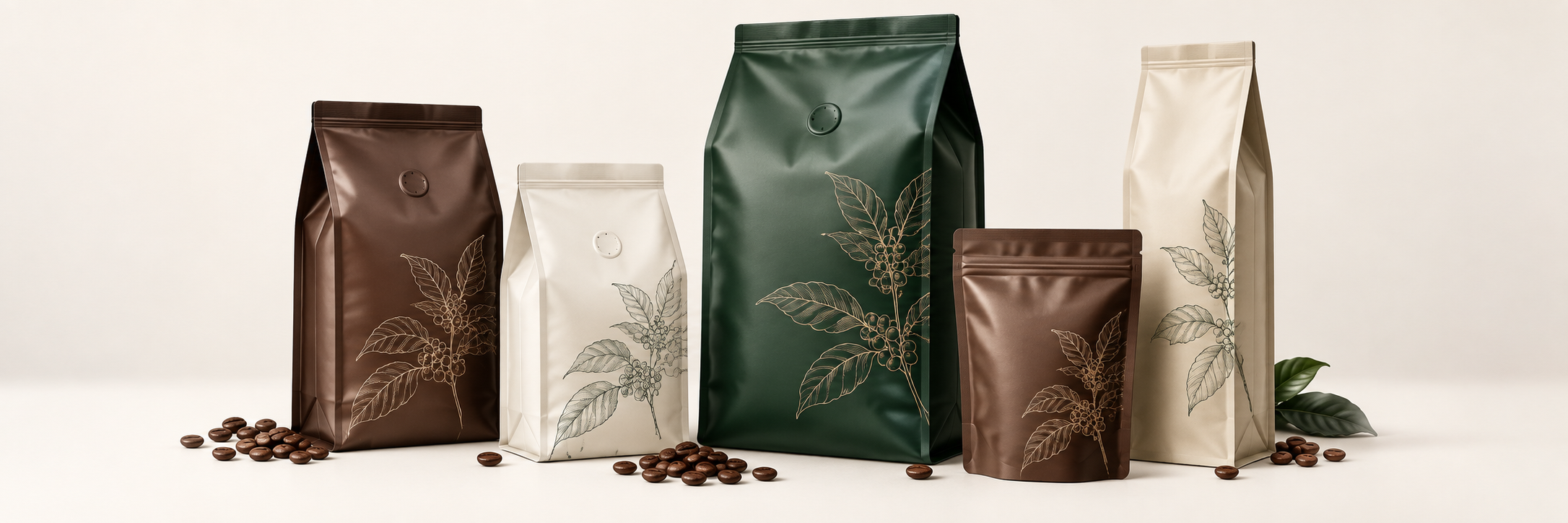
Common options include flat bottom coffee bags, stand up pouches and side gusset bags.
If you have a preferred format, send its name and a reference image. Explain which features you want to keep, such as the shape, zipper position or printable side panels.
A reference image helps communicate appearance, but it cannot confirm the material structure, thickness or exact dimensions.
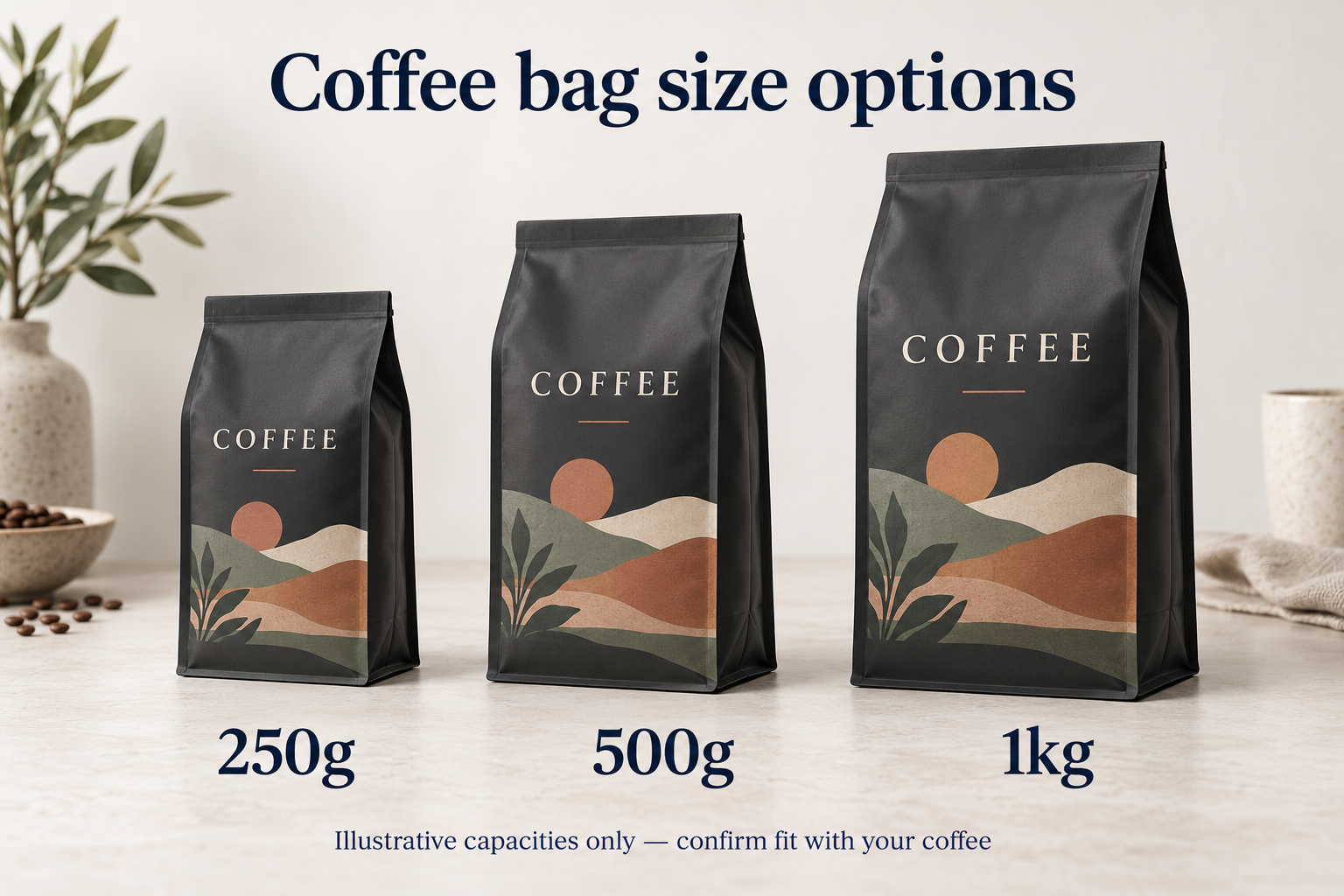
For size, provide your target fill weight first. If you already have a successful bag, share its dimensions and, where practical, a physical sample.
For example, a useful starting brief is:
“We need a flat bottom bag for 250g of whole bean coffee, with a resealable zipper and a degassing valve. Please recommend dimensions for a filling trial.”
Confirm how width, height and gusset measurements are defined on the supplier’s drawing. Different bag styles may use different measurement conventions.
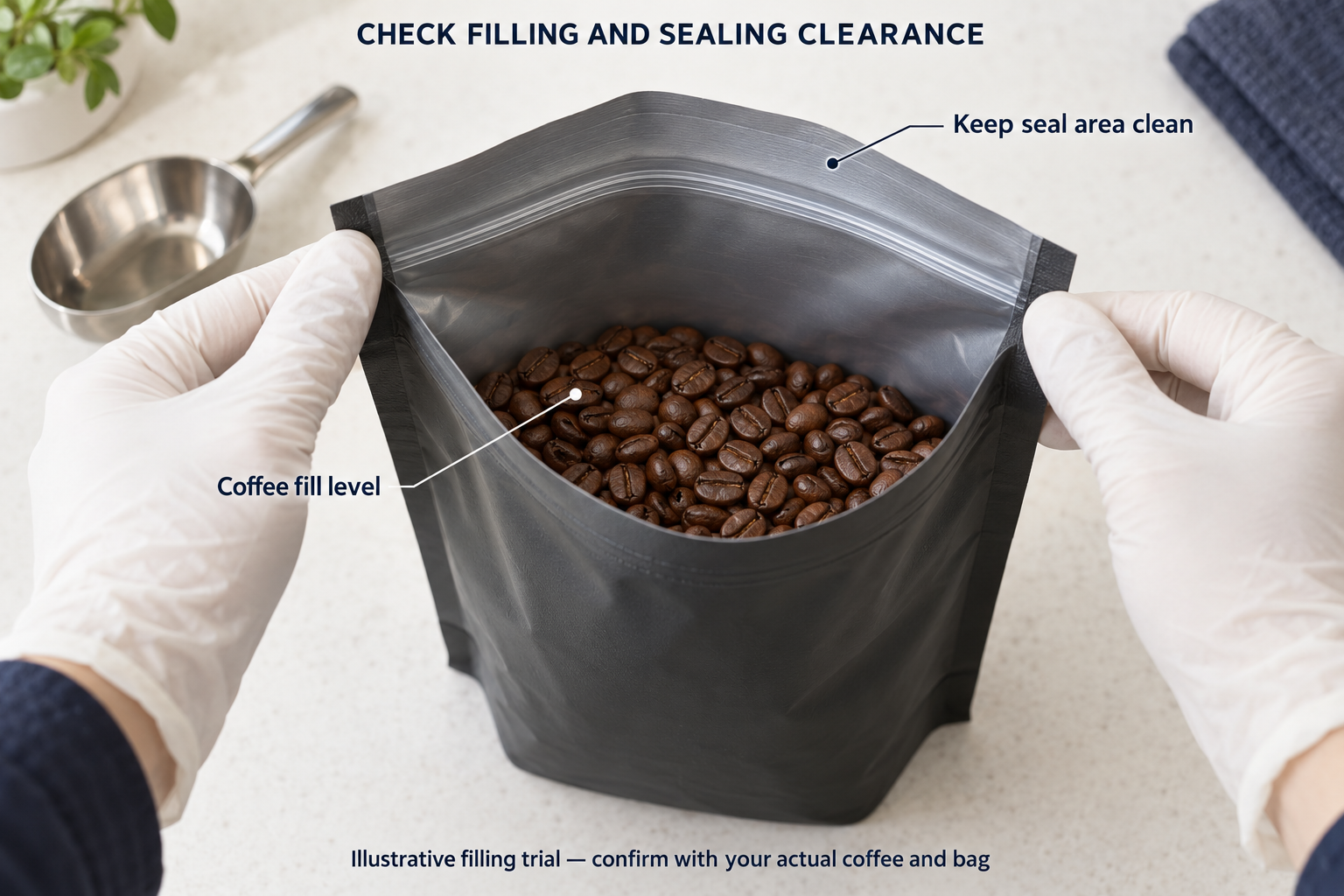
Before approving production, test the proposed size with your own coffee. Leave sufficient room for filling, closure operation and a clean top heat seal.
3. Explain Your Material and Barrier Requirements
If you know your existing material structure, provide the full specification, including the layer structure and thickness where available.
If you do not know it, describe the performance you need. Useful information includes your shelf-life target, storage conditions, distribution method and any appearance requirements, such as a matte finish or a window.
Ask your supplier to explain the proposed structure and provide relevant barrier data. Oxygen transmission rate and water vapor transmission rate should be compared under equivalent test conditions.
Do not select coffee packaging by thickness alone. A thicker bag does not automatically provide a better oxygen barrier.
For packaging described as recyclable, request information about the complete pack, including the film, zipper, valve and labels. Any claim should be appropriate for the market where the finished product will be sold.
4. Specify Valves, Zippers and Opening Features
List the functional features you need and discuss their placement before finalizing the artwork.
| Feature | What to confirm |
|---|---|
| Degassing valve | Suitability for your coffee, position and compatibility with the bag structure |
| Resealable zipper | Position, usable opening and customer reclosure |
| Tear notch | Opening direction and clearance from the zipper |
| Top heat-seal area | Sufficient space for your filling and sealing process |
| Window, if required | Location, appearance and effect on the proposed barrier structure |
A zipper provides reclosure after opening; it does not replace the initial heat seal on a bag designed to be heat sealed.
If your coffee is still releasing significant gas when packed, explain that to the supplier. Valve requirements should be assessed alongside your roast-to-pack schedule.
For ground coffee, ask whether particle protection is needed for the proposed valve.
5. Break Down Quantities by Size and Design
Your total order quantity is only part of the information needed for a quotation.
Suppliers also need to know how that quantity is divided between bag sizes, artwork designs and product variants.
An order for one design may have different setup and production requirements from the same total quantity spread across several designs.
Prepare a simple list showing:
Each bag size or target fill weight.
Each artwork version.
Quantity required for each version.
Features that differ between versions.
Expected repeat-order frequency, if known.
Ask whether the minimum order quantity applies per size, per material structure, per design or under another production grouping.
Also confirm any permitted overrun or underrun and how the final supplied quantity will be invoiced. These terms should be agreed before ordering.
6. Prepare Artwork on the Correct Dieline
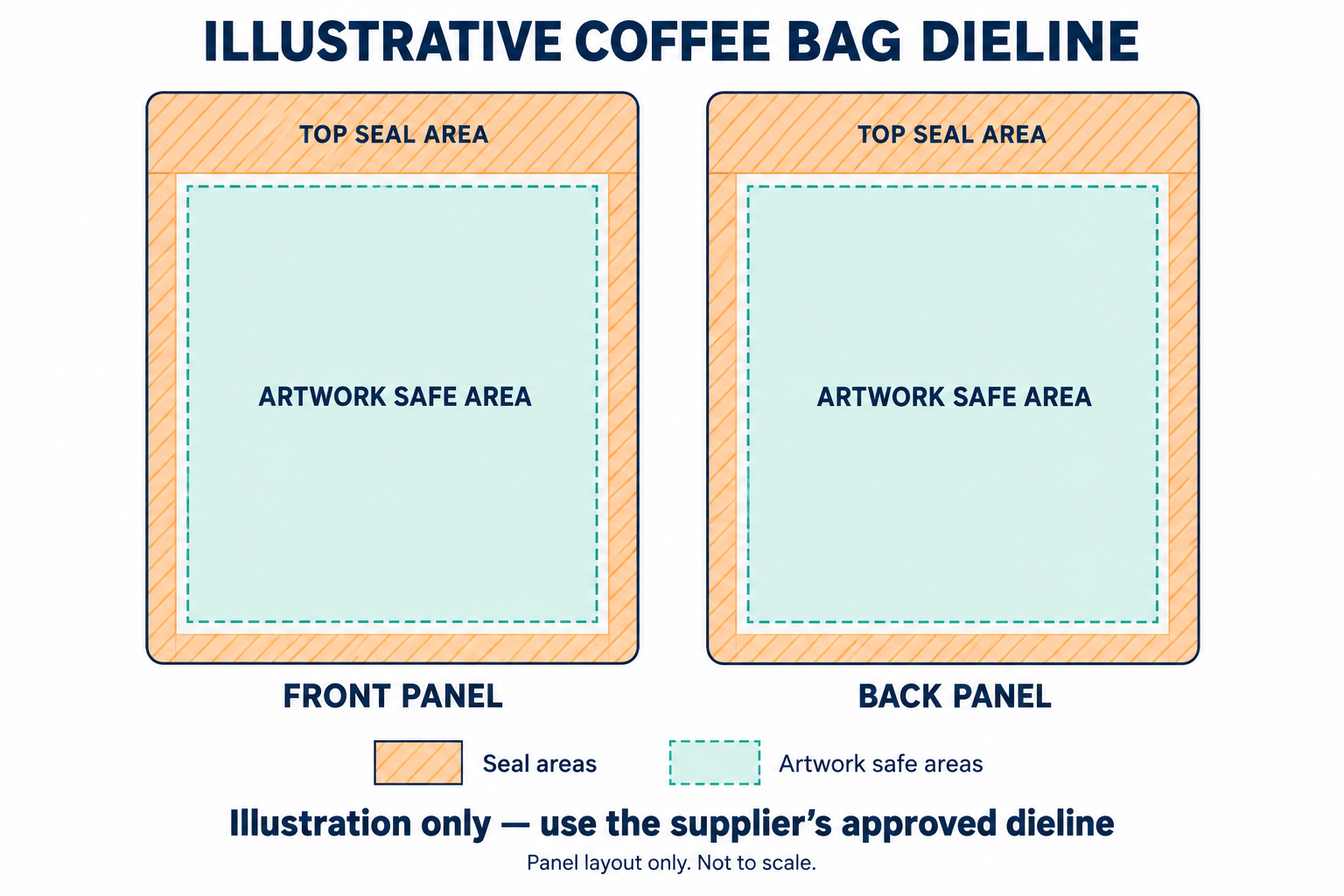
Request the supplier’s approved dieline before completing the print layout.
The dieline should identify the panels, folds, sealing areas and relevant feature positions. Artwork prepared for one bag style should not simply be stretched to fit another.
Before submitting files, check:
Finished bag dimensions and panel orientation.
Bleed and safe areas.
Zipper, valve and seal locations.
Text size and contrast.
Barcode placement.
Color references and finish requirements.
Space for batch codes or date marking.
Required product information for the destination market.
Ask which file formats the supplier accepts and how fonts, linked images and color settings should be prepared.
If several coffees share the same design layout, clearly identify which text, colors and barcodes change between versions. Use consistent file names to reduce the risk of mixing up artwork.
7. Understand What Each Sample or Proof Approves
Not every sample demonstrates the same thing.
| Sample or proof | Main purpose | What it may not confirm |
|---|---|---|
| Existing stock sample | Review a general bag style, material feel or closure | Your exact dimensions, artwork or final specification |
| Digital artwork proof | Check text, panel placement and layout | Final printed color, material feel or physical capacity |
| Physical size sample | Evaluate filling, handling and carton fit | Final print quality or exact production materials, unless specified |
| Printed preproduction sample | Review agreed aspects of print and construction | Every production condition, unless explicitly covered |
Ask what each sample represents and which decisions you are approving.
Keep a written record of the final specification and approved artwork version. If anything changes afterward, confirm whether a new proof or sample is required.
8. Compare the Full Quotation and Delivery Terms
Compare quotations based on equivalent specifications, rather than unit price alone.
Check whether the price includes printing setup, cylinders where applicable, valves, zippers, samples, packing and freight.
For international orders, confirm the named delivery term and location, who handles import clearance, and which taxes or charges are excluded.
Also ask when the production lead time starts. It may depend on payment, artwork approval, sample approval or material availability.
If you have a launch date, share it early and request a schedule that separates:
Artwork and specification approval.
Sample evaluation, where required.
Production.
Inspection and dispatch.
Transport and customs clearance.
Treat an estimated arrival date separately from a guaranteed delivery commitment.
Frequently Asked Questions
Can I request a quotation without knowing the material structure?
Yes. Explain your coffee type, packing process, shelf-life target and sales market. Ask the supplier to propose a structure and explain how it meets your requirements.
Do I need a physical sample before ordering?
A sample is particularly useful when the bag size, format or packing process is new. A filling trial can identify capacity and sealing issues that are difficult to judge from a drawing.
Can I order several designs in the same production run?
Possibly. This depends on the printing method, shared specifications and supplier’s production rules. Provide quantities per design and ask how minimums and setup charges apply.
Will my coffee bag look exactly like the artwork on my screen?
A screen proof is useful for checking content and layout, but it cannot reliably reproduce every printed color or surface finish. Agree on color references and proofing expectations before approval.
What is the minimum information needed to start?
Provide the coffee type, fill weight, preferred bag style, quantity per design, required features and delivery destination. Mention any details that are still undecided.
Prepare Your Custom Coffee Bag Enquiry
To discuss custom coffee bags with FWPacks, send a brief using the following checklist:
Product: whole bean or ground coffee.
Net weight per bag.
Preferred bag style.
Dimensions, if already confirmed.
Material requirements or packaging performance targets.
Valve, zipper and other required features.
Quantity for each size and design.
Artwork status.
Destination country and postal code.
Required delivery date, if applicable.
If you are unsure about a specification, mark it as “to be confirmed.” A clear starting brief helps focus the discussion on suitable options, sample evaluation and an accurate quotation.