Choosing a coffee bag size starts with the weight you want to sell, but weight alone does not tell you which dimensions to order.
A 250g bag of whole beans may need a different usable volume from a 250g bag of ground coffee. Bag shape, coffee density and the space required for filling and sealing also affect the fit.
For coffee brands comparing 250g, 500g and 1kg coffee bags, the most reliable approach is to select a suitable format, test it with the actual coffee and confirm the finished dimensions before approving custom production.
This guide explains what to check at each step.
FWPacks Reference Sizes for Sample Selection
The following dimensions are reproduced from the FWPacks flat bottom vs stand up coffee bag comparison. They are sample-selection starting points, not universal standards or guaranteed filling capacities.
| Intended coffee weight | Flat bottom bag with zipper (cm) | Stand up pouch with zipper (cm) |
|---|---|---|
| 250g | 13 × 20 + 7 | 15 × 23 + 5 |
| 500g | 13.5 × 26.5 + 7.5 | 18 × 29 + 5 |
| 1kg | 15 × 32.5 + 9.5 | 23 × 34 + 5 |
Dimensions retain the original chart notation. Confirm width, height and the folded or expanded gusset convention on the approved drawing. Test with your actual beans or ground coffee and leave room for filling, zipper operation and a clean top seal before approving a size.
1. Coffee Bag Capacity and Dimensions Are Different
Coffee bag capacity usually describes the intended product weight, such as 250g, 500g or 1kg. Dimensions describe the physical package.
These measurements are related, but they are not interchangeable.
Two bags advertised for 250g of coffee can have different widths, heights and gussets. They may both work for a particular coffee, yet create different fill levels and shelf appearances.
Likewise, two bags with similar external dimensions may have different usable volumes because of their construction, seals or closure placement.
When asking a supplier about coffee bag sizes, provide both:
Your target net weight.
Whether you pack whole beans or ground coffee.
The supplier can then recommend sample sizes for a filling trial. Treat a stated capacity as a starting point until it has been checked with your product.
2. Common Coffee Pack Weights and Their Uses
Pack weight should reflect how your customers buy and use coffee.
The following table offers practical starting points. These are packaging options, not universal standards.
| Target net weight | Possible application | What to check |
|---|---|---|
| 100g–125g | Tasting packs, discovery sets and limited releases | Space for required information, convenient filling and a proportionate pack shape |
| 200g–250g | Retail whole-bean or ground-coffee packs | Shelf presentation, closure access and adequate sealing clearance |
| 340g / 12 oz | Retail ranges using a 12 oz pack format | The exact declared weight and the fit of the coffee being packed |
| 500g | Larger retail packs, subscriptions and frequent-use purchases | Ease of pouring, storage after opening and resealability |
| 1kg | Café supply, office use and larger household purchases | Handling strength, filled stability and compatibility with packing equipment |
A 12 oz pack is approximately 340g, so it should not automatically use the same bag as a 250g pack.
If your range includes several weights, keep the visual design consistent while checking each size independently. A design that works well on a 250g pouch may need layout changes for a taller or wider 1kg bag.
3. Why the Same Weight Can Need Different Bag Sizes
Coffee occupies space differently depending on the product and how it is filled.
Whole Beans and Ground Coffee
Whole beans leave spaces between individual beans. Grinding changes how the coffee packs together, so ground coffee and whole beans may occupy different volumes at the same weight.
Do not assume a bag tested with one format will fit the other equally well.
Roast Profile and Bean Characteristics
Roasting changes bean mass and volume. Bean size, origin and roast profile can therefore affect the volume needed for a given weight.
A size that comfortably fits one coffee may appear more tightly filled with another. If several products will share one bag specification, test representative coffees across the range.
Filling and Settling
Coffee may settle after filling and during handling. The pack should work during the filling process as well as after the product has settled.
Avoid choosing a bag that only fits the target weight after repeated shaking or manual compression unless that step is part of your validated packing process.
4. How Bag Style Affects Size Selection
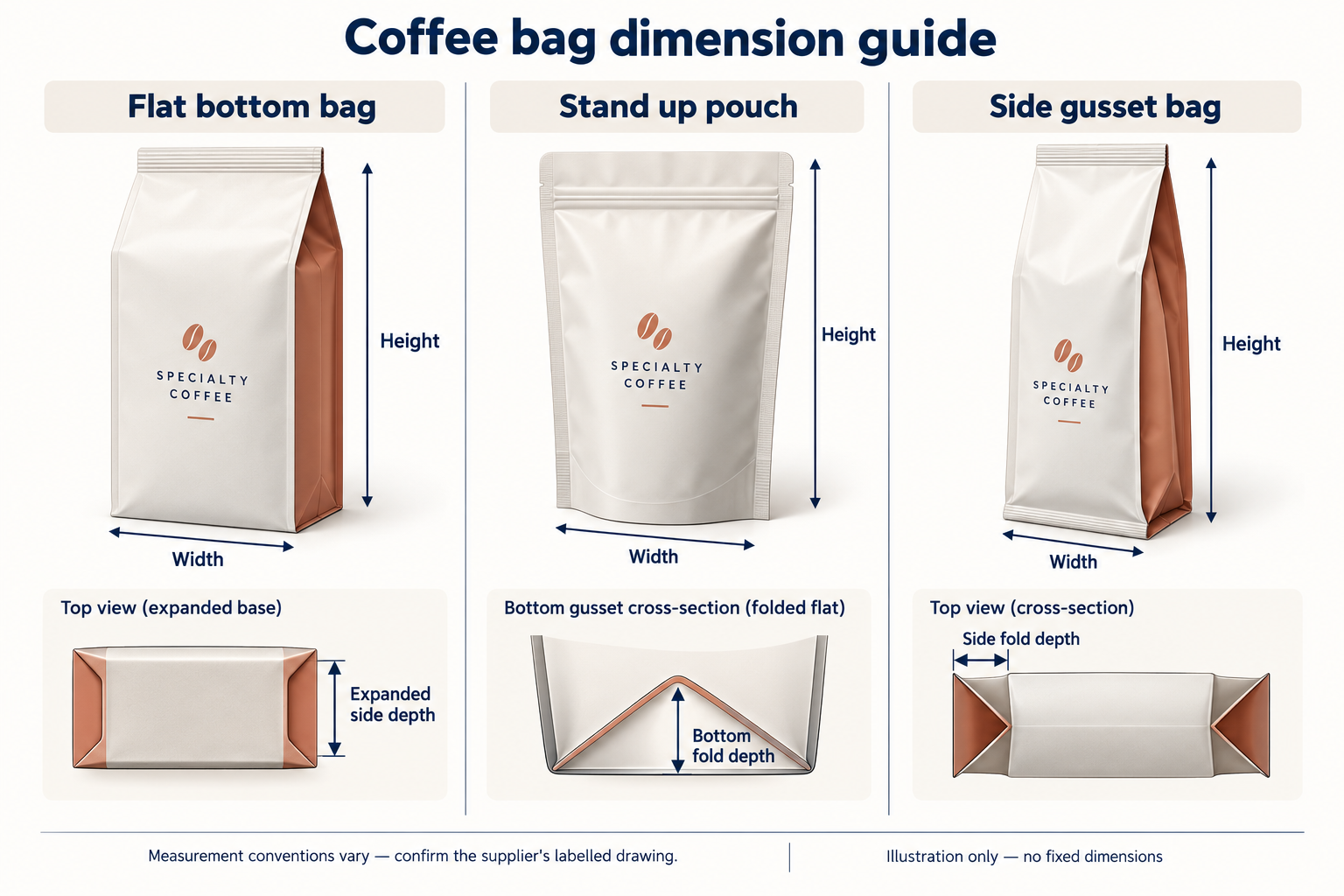
Flat bottom bags, stand up pouches and side gusset bags distribute their internal volume differently.
| Bag style | How the shape affects the pack | Size-selection consideration |
|---|---|---|
| Flat bottom bag | A defined base and side gussets create a box-like filled shape | Confirm the width, height and base or gusset measurements on the supplier’s drawing |
| Stand up pouch | A bottom gusset opens as the pouch fills | Check usable volume and filled stability, rather than judging capacity from the flat front panel |
| Side gusset bag | Side folds expand around the coffee | Confirm the expanded depth and the space needed for the intended top closure |
The same nominal width and height do not guarantee the same capacity across these formats.
Dimension notation also varies between suppliers. A measurement described as “gusset” may refer to a folded depth or an expanded measurement, depending on the drawing.
Ask for a labelled dimensional drawing instead of relying on a size written only as three numbers.
5. What to Check for 250g, 500g and 1kg Coffee Bags
250g Coffee Bags
For a 250g retail pack, consider how the bag looks when filled, how easily it stands and whether customers can open and use the closure comfortably.
Check that the package leaves enough room for branding and required product information without making the front panel unnecessarily crowded.
If you sell both whole beans and ground coffee, test both before committing to one shared size.
500g Coffee Bags
A 500g bag needs enough usable volume for the coffee and enough opening space for practical filling.
Check pouring and resealing as well as the initial appearance. A narrow opening or awkward zipper position can make a pack inconvenient even when its stated capacity is sufficient.
1kg Coffee Bags
For a 1kg pack, assess the complete filled package: the material structure, seals, closure and handling performance all matter.
If you use filling equipment, confirm that the bag opening and dimensions work with the filling spout and bag-handling system.
Also check how filled bags fit into shipping cartons. A package that looks suitable on its own may use carton space inefficiently.
There is no single width, height and gusset combination that is correct for every coffee at these weights.
6. Leave Enough Space for Filling and Top Sealing
A bag needs room for more than the coffee itself.
The opening must accommodate filling, and the top seal area must remain clear of beans, grounds and other contamination. If a zipper is included, its position also affects the usable space and filling access.
Before approving a size, check:
Whether the filling spout can enter the opening comfortably.
Whether the target weight fits without forced compression.
Whether the intended top sealing area remains clean.
Whether the zipper can close without interference.
Whether any valve placement works with the filled shape and artwork.
There is no universal sealing-clearance measurement for every coffee bag. The required allowance depends on the bag construction, closure layout and sealing equipment.
Confirm the usable fill level and sealing area with your supplier, then verify them in a trial.
7. Run a Filling Trial Before Approving Production
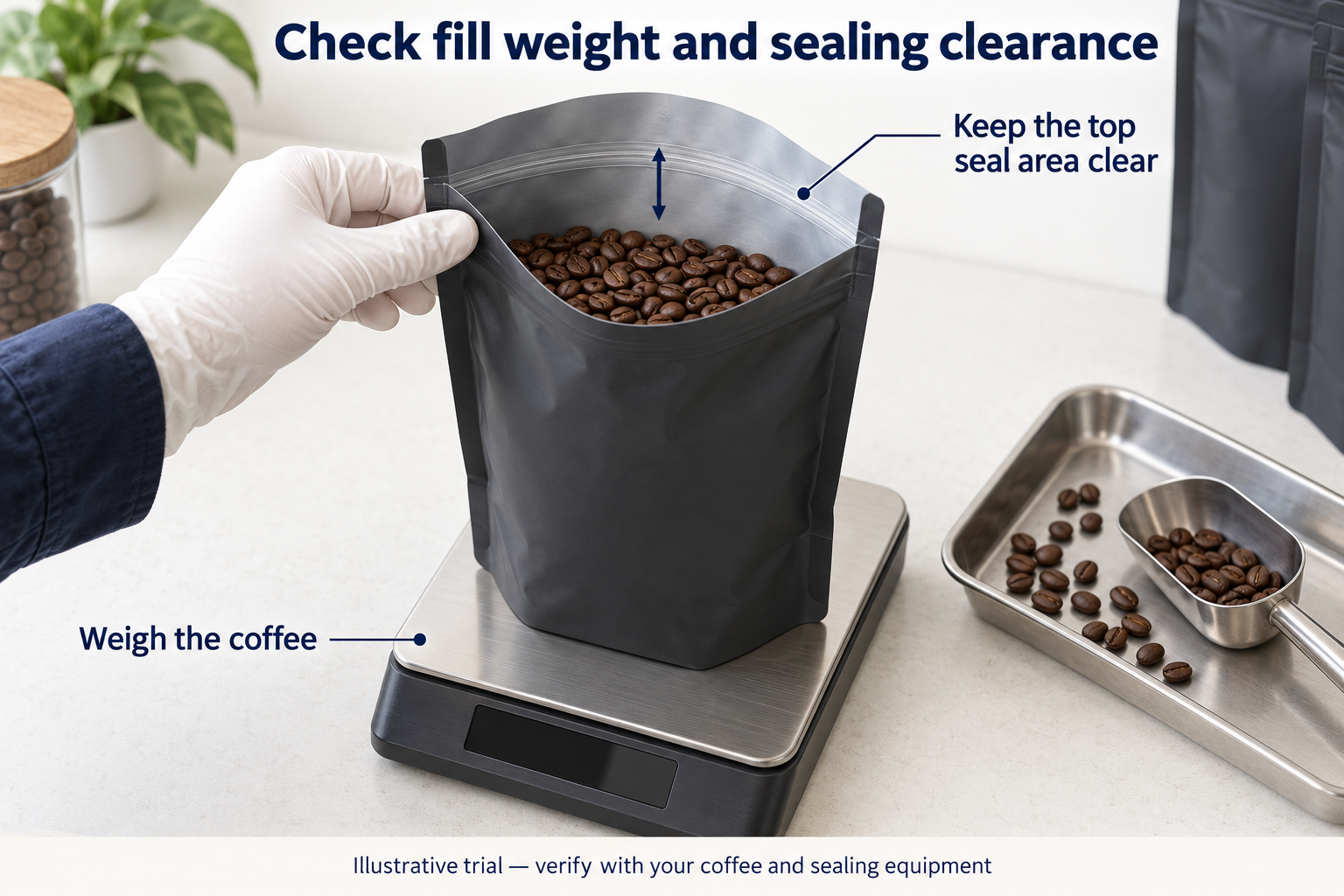
A simple trial can reveal problems that a dimension chart cannot.
Step 1: Obtain representative bag samples.
Use samples with the proposed dimensions and, where possible, the intended material structure and closure arrangement. Differences in stiffness or construction can affect how the bag fills and stands.
Step 2: Weigh the actual coffee.
Test the product you plan to sell at its intended net weight. If multiple coffees will share the bag, include products that may occupy different volumes.
Step 3: Fill using the intended method.
Check the opening, filling access and whether the coffee fits without extra handling that would slow production.
Step 4: Check closure and sealing clearance.
Keep the seal area clean and confirm that the coffee does not interfere with the zipper or sealing jaws.
Step 5: Seal and inspect the pack.
Evaluate the filled shape, stability and visible strain around the seals. Visual checks are useful, but seal integrity and handling performance may also require appropriate testing.
Step 6: Test normal handling and carton fit.
Check pouring, resealing and the arrangement of filled bags inside the intended shipping carton.
Step 7: Record the approved specification.
Keep the dimensions, material structure, closure positions, sample reference and trial notes together so the production order matches what was evaluated.
8. What to Send Your Supplier for a Size Recommendation
A clear enquiry helps your supplier narrow down the sample options.
Include:
Target net weight for each pack.
Whole beans or ground coffee.
Preferred bag style.
Details of any existing bag that fits well or poorly.
Manual or machine filling.
Zipper and degassing-valve requirements.
Any shelf, label or carton-size constraints.
Whether several coffees need to use the same bag.
Expected order quantity for each size and design.
If you already have a suitable bag, send its dimensions together with a labelled photo or drawing. Explain how it was measured, including the gusset.
Ask the supplier to confirm the proposed specification in writing and provide samples for a practical fit check.
Frequently Asked Questions
What size bag do I need for 250g of coffee?
Start with a supplier’s suggested 250g coffee bag, then test it with your actual coffee. Whole beans, ground coffee, bag style and sealing requirements can all affect the dimensions you need.
Can I use the same bag for whole beans and ground coffee?
Possibly, but both products should be tested. Equal weight does not necessarily mean equal volume or the same filled appearance.
Are coffee bag dimensions standard across suppliers?
No. Suppliers may offer different dimensions for the same stated capacity and may describe gussets differently. Use a labelled drawing to confirm the measurements.
Should a coffee bag be filled completely to the top?
No. The package needs adequate room for the intended filling, closure and sealing process. Confirm the appropriate fill level through a packing trial.
Can one bag size work for several roast profiles?
It may, provided representative coffees fit comfortably and the pack performs as intended. Test the range before approving a shared specification.
Does a larger bag keep coffee fresher?
Bag size alone does not determine freshness. Barrier properties, seal integrity, residual oxygen, storage conditions and the packing process also matter. Choose a size that fits the product and works with your validated packaging process.
Discuss Your Coffee Bag Size with FWPacks
Preparing a new 250g, 500g or 1kg coffee pack?
Send FWPacks your target weight, coffee format, preferred bag style and filling method. Include any existing bag dimensions or fit concerns so the enquiry can focus on suitable packaging options.
Confirm the final size with actual coffee samples before approving custom production.
Explore custom coffee bags from FWPacks or contact our team for a size and sample enquiry.